
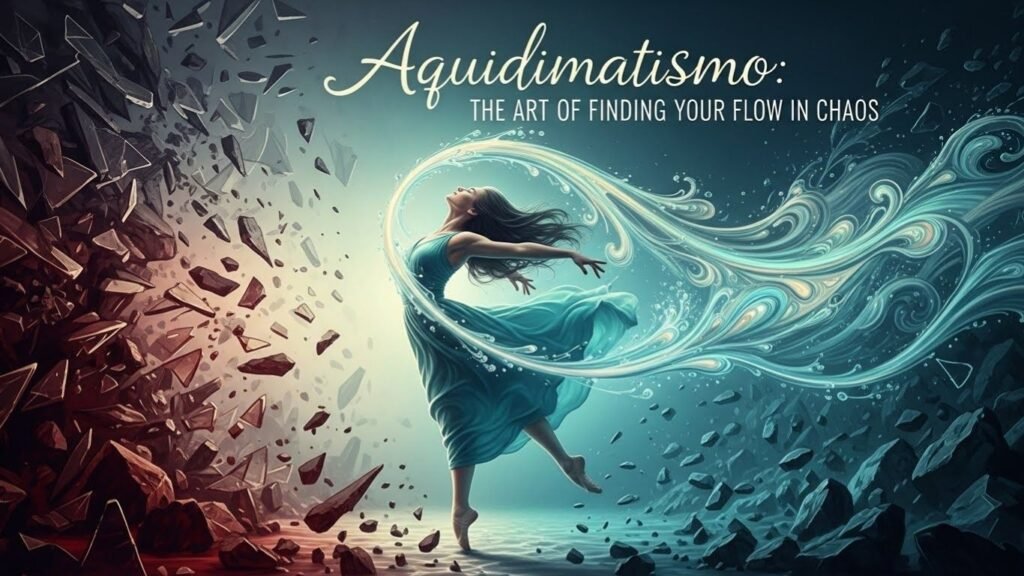
Do you ever feel like your brain is a browser with 50 tabs open, and you can’t figure out where the music is coming from? You aren’t alone. We live in an era where “busy” is worn like a badge of honor and silence feels uncomfortable. But what if the answer isn’t doing more, or even doing less, but simply finding a better rhythm?
Enter aquidimatismo.
This isn’t just another buzzword to add to your vocabulary alongside “synergy” or “hustle.” It is a practical philosophy that is quietly changing how people approach their days. It is about balancing where you are (presence) with where you are going (purpose).
If you are tired of the constant tug-of-war between burnout and boredom, this guide will walk you through exactly what aquidimatismo is and how to use it to reclaim your time and energy.
What is Aquidimatismo?
At its core, aquidimatismo is the practice of balancing mindful presence with purposeful action. It bridges the gap between sitting on a meditation cushion and crushing a deadline at work.
The term itself is a blend of linguistic roots. It combines “aqui” (meaning “here”) with concepts of “dima” (balance or dimension). It essentially translates to finding equilibrium right here, right now.
Unlike traditional mindfulness, which often focuses solely on observation and acceptance, aquidimatismo is active. It asks you to be present while you move, work, and create. It’s the difference between watching the river flow and steering your boat skillfully down the current.
Why It Matters Now
We are drowning in distractions. The average person checks their phone 58 times a day. Our attention spans are shrinking, and our stress levels are skyrocketing.
Old productivity models told us to manage our time. Aquidimatismo tells us to manage our energy. It suggests that success doesn’t come from forcing yourself to work against your natural rhythm, but from aligning your actions with your current state of being.
The Core Principles of Aquidimatismo
To truly understand this philosophy, you need to look at its three main pillars. These aren’t rigid rules, but rather guideposts to help you navigate your day.
Presence Over Pressure
Have you ever tried to write an email while listening to a podcast and cooking dinner? How did that turn out? Probably not great.
The first principle, Presence Over Pressure, encourages single-tasking. It is about giving your full attention to the task at hand. When you are writing, just write. When you are eating, just eat.
This doesn’t mean you have to be slow. It means you stop leaking energy by constantly switching contexts. By reducing the mental friction of multitasking, you actually get things done faster and with fewer errors.
Intentional Action
Movement without direction is just chaos. Intentional Action is about making conscious choices rather than reacting to whatever screams the loudest.
Before you start a task, aquidimatismo asks you to pause for five seconds and ask: “Does this align with what I need to achieve today?” This simple pause prevents you from spending hours on “busy work” that doesn’t actually move the needle on your goals.
Adaptive Balance
This is the secret sauce. Adaptive Balance acknowledges that you are not a robot. You cannot operate at 100% efficiency every hour of every day.
Some days you will have high energy; other days you will feel drained. Instead of fighting these fluctuations, aquidimatismo encourages you to adapt. Push hard when the energy is there. Rest and recover when it isn’t. This flexibility prevents the boom-and-bust cycle of burnout.
The Science: Why Your Brain Loves Aquidimatismo
This isn’t just “woo-woo” magic; there is real neuroscience at play here. Aquidimatismo effectively blends the benefits of mindfulness with the power of the flow state.
The Neuroscience of Flow
You might know “flow” as being “in the zone.” It was popularized by psychologist Mihály Csíkszentmihályi. In this state, your brain waves slow down from the erratic beta state to the smoother alpha and theta states. Your prefrontal cortex—the part of the brain responsible for self-doubt and overthinking—actually quiets down.
Aquidimatismo creates the perfect conditions for flow. By removing distractions (Presence) and setting clear goals (Intention), you lower the cognitive load on your brain. This makes it easier to slip into that deep, focused state where work feels effortless.
Stress Reduction and the Amygdala
Constant rushing keeps your amygdala (the brain’s fear center) on high alert. This floods your body with cortisol. By practicing the adaptive balance of aquidimatismo, you signal to your nervous system that you are safe. This lowers stress hormones, improves immune function, and creates a sense of calm—even when your to-do list is full.
7 Benefits of Practicing Aquidimatismo
When you stop fighting your natural rhythm, things start to change. Here is what you can expect:
- Reduced Anxiety: You stop worrying about the future because you are fully engaged with the present.
- Higher Quality Work: Single-tasking leads to fewer mistakes and deeper insights.
- More Energy: You stop wasting mental fuel on context-switching and resistance.
- Better Decisions: A calm mind makes smarter choices than a frantic one.
- Emotional Resilience: You learn to bend with stress rather than breaking.
- Enhanced Creativity: Flow states are where your best ideas live.
- Greater Satisfaction: You finish the day feeling accomplished, not just exhausted.
How to Practice Aquidimatismo in Daily Life
You don’t need to move to a monastery or buy expensive equipment. You can start practicing right now, in the middle of your messy, busy life.
Morning Mindfulness (The 5-Minute Reset)
Before you look at your phone, give yourself five minutes. Sit on the edge of your bed. Focus on your breath. Set one intention for the day. It could be “I will finish the report” or “I will be patient with my kids.” This anchors your brain before the digital noise begins.
The “Energy Check-In”
Set a timer to go off three times a day. When it beeps, stop. Ask yourself: “How is my energy right now? High, medium, or low?”
- High: Tackle your hardest task.
- Medium: Do routine work (emails, admin).
- Low: Take a break, walk, or do low-stakes creative work.
Flow-Based Scheduling
Instead of scheduling tasks by time (e.g., “9:00 AM – Write Report”), schedule them by energy. Group similar tasks together. Do all your writing at once. Do all your calls in a block. This reduces the mental cost of switching gears.
Digital Mindfulness
You cannot find flow if your phone pings every 3 minutes. Create “deep work” zones. Turn on “Do Not Disturb.” Put your phone in a drawer. Train your brain that when the phone is away, it is time to focus.
Real-Life Applications: Success Stories
Take “Sarah,” a marketing manager. She was burned out, answering emails at 10 PM, and feeling like she was spinning her wheels. She started applying aquidimatismo by using Adaptive Balance.
She realized her energy peaked at 10 AM and crashed at 3 PM. She rearranged her day to do creative strategy in the morning and administrative meetings in the afternoon. Within two weeks, she was leaving the office at 5 PM with more work done than before.
Or consider “David,” a freelance writer. He struggled with procrastination. By using Intentional Action, he stopped waiting for “inspiration.” He simply committed to 10 minutes of single-tasking. Usually, once he started, the flow state took over, and 10 minutes turned into two hours.
Aquidimatismo vs. The Rest
How does this stack up against other popular methods?
| Philosophy | Focus | The Aquidimatismo Difference |
|---|---|---|
| Mindfulness | Awareness & Acceptance | Adds action. It’s not just sitting; it’s doing with awareness. |
| Hustle Culture | Speed & Volume | Prioritizes sustainability. It’s a marathon, not a sprint. |
| Flow State | Peak Performance | Focuses on the lifestyle that makes flow possible, not just the peak moments. |
Overcoming Common Challenges
It won’t be perfect immediately. Here are the hurdles you might face:
“I don’t have time to slow down.”
paradoxically, slowing down to focus makes you faster. Start with just 10 minutes a day. You will likely gain back an hour in productivity.
“My mind won’t shut up.”
That’s normal. Aquidimatismo isn’t about having an empty mind. It’s about noticing the noise and gently bringing your focus back to the task.
“I keep forgetting to practice.”
Use environmental cues. Put a sticky note on your monitor that says “Aqui” (Here). It serves as a visual trigger to bring you back to the present.
Getting Started: The 7-Day Challenge
Ready to try it? Here is a simple plan for your first week.
- Day 1: Observe. Just notice when you are distracted. Don’t judge it.
- Day 2: The Morning Pause. Do the 5-minute breathing exercise before checking your phone.
- Day 3: Single-Tasking. Pick one chore (dishes, email) and do only that until it’s done.
- Day 4: The Energy Check. Ask yourself “High, Medium, or Low?” at noon.
- Day 5: Digital Detox. Turn off notifications for one 2-hour block.
- Day 6: Intentional Rest. Take a break without scrolling. Look out a window or walk.
- Day 7: Reflection. Look back at the week. When did you feel most in flow?
Conclusion
Aquidimatismo teaches us that balance isn’t a final destination you arrive at; it’s a way of walking. It is the constant, gentle adjustment to the terrain of your life. By choosing presence over pressure and intention over habit, you can stop fighting the current and start flowing with it.
You don’t need to change your entire life overnight. Just start here. Start now.
Frequently Asked Questions (FAQs)
1. Is aquidimatismo a religion?
No, it is a secular philosophy and lifestyle practice focused on productivity, well-being, and mental balance.
2. How long does it take to see results?
Most people feel a sense of relief immediately after their first “intentional pause.” deeper benefits like improved focus and reduced burnout usually appear after about two weeks of consistent practice.
3. Can I practice this if I have a chaotic job?
Absolutely. In fact, people in high-stress, chaotic environments (like ER nurses or stock traders) often benefit the most because it helps them stay calm in the eye of the storm.
4. Do I need to meditate to practice aquidimatismo?
While meditation helps, it isn’t strictly required. The “meditation” in aquidimatismo is often the act of doing your daily tasks with total focus and awareness.
5. Is this the same as “slow living”?
Not exactly. Slow living often focuses on reducing the pace of life. Aquidimatismo accepts that life can be fast, but teaches you how to move through that speed without internal chaos.